Character Assets
Assets represent your background, skills, and traits. They give you additional options and bonuses when making a move—or sometimes act as their own self-contained moves.
Assets provide both mechanical and narrative benefits. For example, if you are an Herbalist, you gain bonuses to your moves when treating injuries or sicknesses. You can envision your character identifying plants, diagnosing rare illnesses, and summoning up obscure facts about herbal remedies. Even when you aren’t making moves, your role colors the interests and manner of your character. Also, your expertise might offer story possibilities and new quests as you interact with others in need of your services.
Ironsworn assets are formatted as printable cards, available for download at ironswornrpg.com. Put them alongside your character sheet for easy reference. Each asset card includes three abilities.
Asset Types
There are four types of assets: Companions, paths, combat talents, and rituals. You can mix-and-match assets as you like—whatever fits your vision for your character and their experiences and goals.
Companions
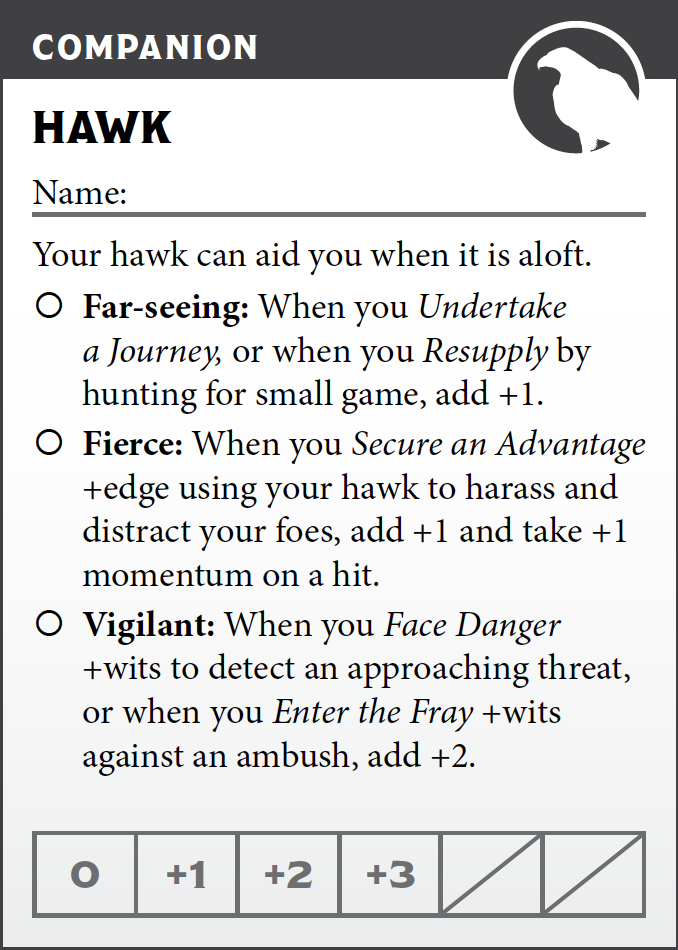
Companions are your NPC helpers. When you acquire a companion, give them a name and envision their appearance and personality. If they don’t have a starting ability, choose one. Upgrading a companion enables additional abilities.
Companions utilize a health track and may suffer harm as a result of one of your moves. When your companion takes damage, make the C_ompanion Endure Harm_ move (page 94) to determine the outcome. See page 43 to learn more.
Paths
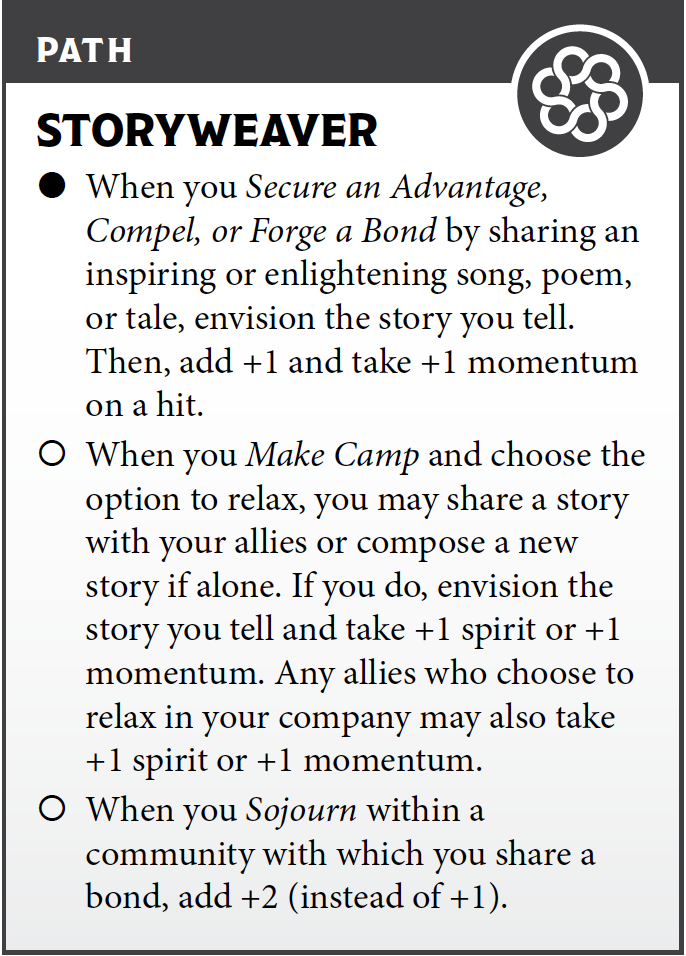
Paths represent your background, interests, training, and skills. They provide mechanical and narrative advantages, but also reflect who you are and how you interact with the world. For example, a Ritualist would likely have a different outlook than a Veteran. Choosing both those paths can reflect an evolution of your character or an interesting background.
Combat Talents
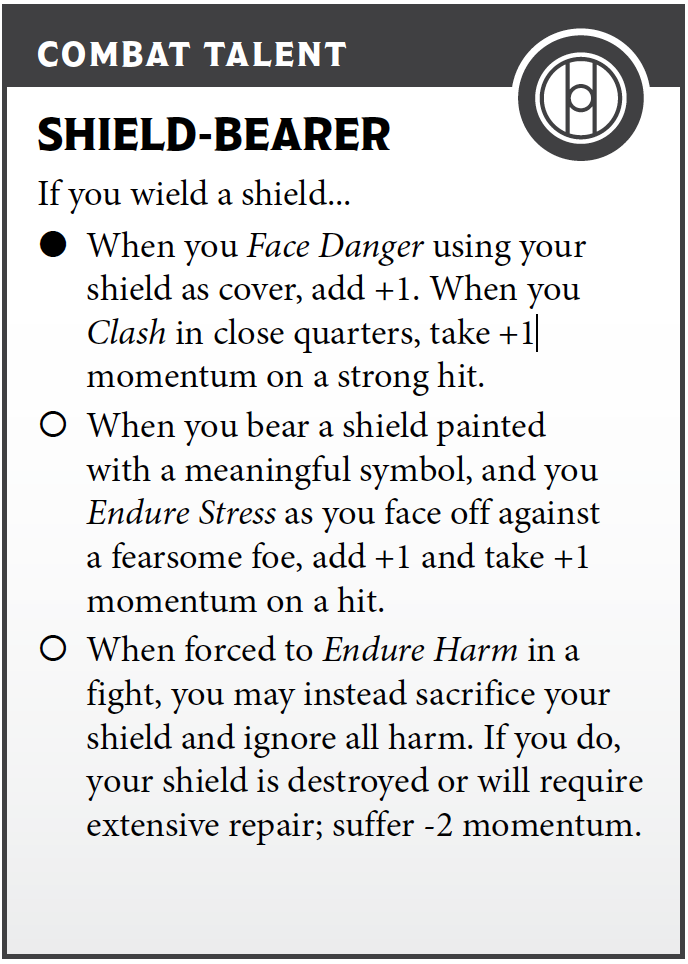
Ironsworn characters are assumed to be skilled fighters. Even without a combat talent, you can wield weapons and perform combat moves (page 78). A combat talent reflects a particular area of expertise, and gives you additional options and bonuses.
Combat talent assets typically require you to wield a specific weapon, as noted in the asset text. For example, if you are a Shield-Bearer and don’t have a shield at the ready, you can’t use the asset’s abilities.
Rituals
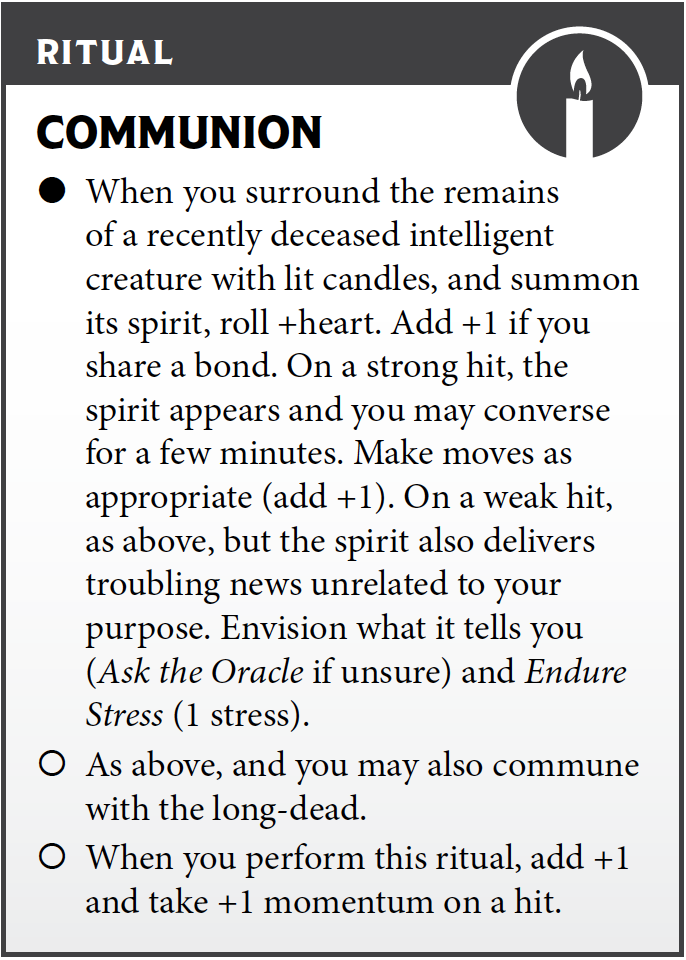
Magic in Ironsworn is cast through rituals which help support your actions or act as unique moves. Like all assets, rituals can be selected as you gain experience and can be upgraded over time to make them more flexible or powerful.
All rituals utilize a move as their default marked ability. You must make this move and the associated action roll to trigger the effect. Any secondary abilities you gain by upgrading the asset are dependent on performing the ritual described as the default ability.
Acquiring Assets
You may select three assets when you create your character. Additional assets can be acquired with experience points when you Advance (page 103).
Some assets can only be obtained after you have fulfilled narrative or mechanical requirements. This is in addition to the experience point cost. The text of the assets will outline the requirements. For example:
- Banner-Sworn requires that you have marked a bond with a leader or faction. If you have an appropriate background bond, or have made the Forge a Bond move with a leader or faction, you may add the asset.
- Battle-Scarred requires that you are maimed (page 38). If you have marked the debility, you may add the asset.
- Ritualist requires that you Fulfill Your Vow in service to an elder mystic, and Forge a Bond to train with them. Once you’ve done that, you may add the asset.
For assets without a requirement, you should consider the narrative justification when you add it to your character. What have you done to gain these abilities? How have your goals changed to support this new focus? Make your selection meaningful in the context of your story.
Upgrading Assets
When you spend experience (page 44) to upgrade an asset, you fill in the dot on your asset card to show you’ve acquired the ability. All assets include three abilities. The first will probably be filled in when you purchase the asset. If not, you get to choose one of the three abilities to start.
Upgrading an asset costs 2 experience. Abilities may be selected in any order. You don’t have to activate the second ability to upgrade the third one.
Asset Abilities
Assets provide one or more functions.
- They provide bonuses (adds) for specific moves.
- They allow you to alter the outcome of a move by rerolling dice.
- They provide improved outcomes for successful moves, such as taking +1 momentum on a hit.
- They give you an option to exchange one resource for another, such as trading momentum for inflicting additional harm.
- They allow you to use moves in unusual circumstances, such as using the Scrying ritual to Gather Information remotely.
- They allow you to use a different stat instead of the one normally required by a move.
- They provide unique self-contained moves.
- They add narrative detail and create situations where you can reveal more about your character or your world.
Follow the directions on the asset to apply its abilities to your current situation.
Ability Requirements
Narrative circumstances and the outcome of failed moves may force you into situations where you can’t leverage a key asset, making your adventure more challenging and dramatic.
For example, if you don’t have a animal pelt, you can’t perform the Bind ritual. If you Undertake a Journey without your Horse companion, you won’t gain the bonus. If you are an Archer who’s run out of arrows, you’ll have to try something else. Before you make a move using an asset, take a moment to ensure you are properly positioned and equipped to use those abilities.
Using Companion Abilities
If you have a companion, leveraging their abilities is an option, not a requirement. Through the fiction, you can interact with your companion and have them perform tasks or assist you without using one of the asset abilities. For example, a Horse companion can put you in position to travel at speed or get away from danger.
When you leverage a companion’s ability, you are inherently putting them at risk. If you roll a 1 on your action die when aided by a companion, any negative outcome of the move should involve your companion. Depending on the circumstances, they might suffer harm, be put in danger, become separated from you, or refuse your commands.
Inflicting Harm on Companions
When a companion suffers physical damage, you make the Companion Endure Harm move (page 94). When their health is at 0, they are in danger of being killed. Some moves, such as Sojourn (page 71) and Make Camp (page 64), offer options for your companion to recover health.
Slain Companions
If your companion is killed, give yourself 1 experience point for each marked ability. Then, remove the asset. If you acquire the same type of companion through the narrative of your quest and journeys, you can rebuy the asset at the normal cost.
Failing an Asset Move
For the sake of brevity, moves within an asset do not usually describe the result of a miss. If an asset offers a self-contained move, and doesn’t provide a specific consequence for a miss, you can leverage the miss result of the Face Danger move (page 60): “On a miss, you fail, or your progress is undermined by a dramatic and costly turn of events. Pay the Price.” In short, make something negative happen as appropriate to the circumstances.
Failed Rituals
Dabbling in the mystic arts is dangerous, and the results can be unpredictable. If the ritual goes wrong, envision what sort of backlash might be possible, or Ask the Oracle. You’ll also find a Mystic Backlash table on page 189.
Failing a ritual might also lead to an entirely mundane result. Perhaps you were ambushed in the midst of the ritual. Or, you waste time (suffer -momentum) or resources (suffer -supply). You might choose to save any overt supernatural backlash for special circumstances, such as when you roll a match.
Using Asset Cards
Booklets of asset cards are available for download at ironswornrpg.com. You can print and cut out individual cards, and each is sized for use with standard 3.5x2.5 in (88x63mm) card protectors.
Or, you can purchase decks of preprinted asset cards. Visit ironswornrpg.com to learn more.
Select three starting aspects
To start, select three assets. Since this is a key aspect of your character, feel free to choose assets as the first step in character creation. You can let your assets guide your concept, or vice versa.