Managing Your Quests
Sworn quests are the narrative engine of your Ironsworn adventures. When you start your campaign, your character has two vows: Your background vow (page 195), and a vow triggered by an inciting incident (page 196).
Making progress in these quests requires you to face and surmount obstacles. You will undertake perilous journeys, uncover information, gain the support of NPCs, recover important items, and defeat powerful foes. Your character will struggle to overcome their own limitations and find their preconceptions and loyalties challenged.
Putting these obstacles in your path isn’t just for dramatic purposes. Succeeding against these trials, finding your way forward, enables you to reach milestones and mark progress on your quests.
Choose your vows
In the fiction, an iron vow is a significant, deeply held promise. If a situation is not dramatic and relevant to your character’s goals and principles, it’s probably not worthy of a vow. It might be a milestone for a quest, or simply a narrative diversion as an opportunity for roleplaying or worldbuilding.
If you want to take on an Ironsworn quest, but the problem in front of you doesn’t seem meaningful enough, punch it up. Give it context. Up the stakes.
Reaching Milestones
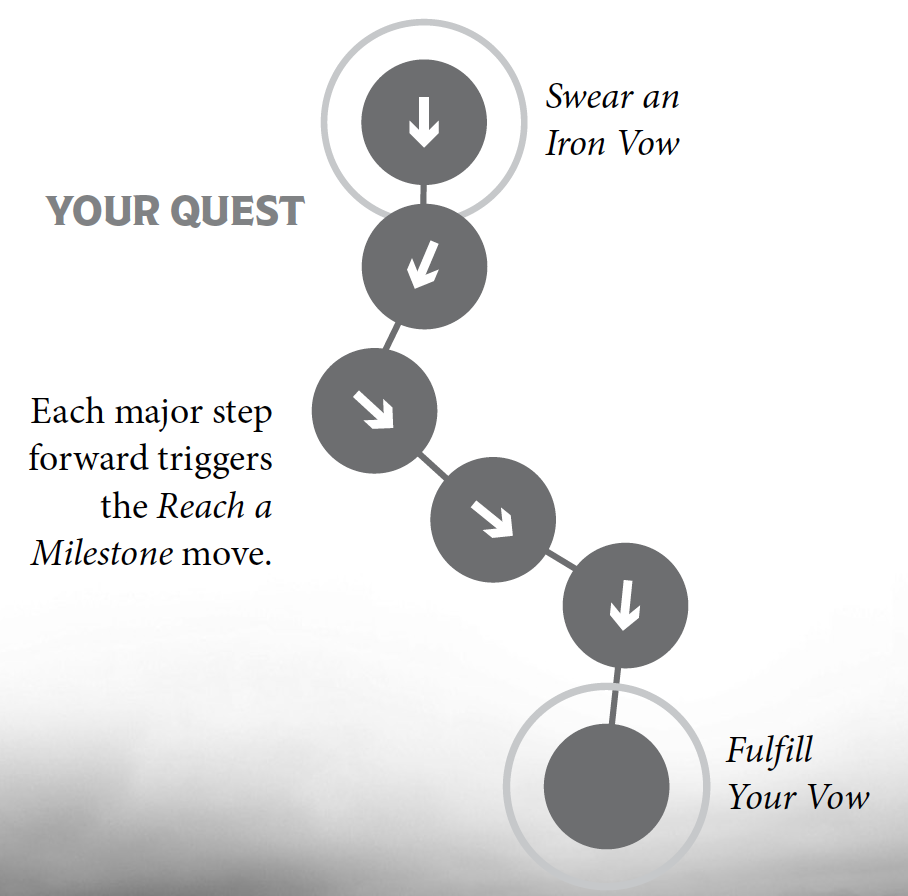
Imagine your Ironsworn quest as a path of stones leading across the water. Each stone marks a major step forward—a milestone—triggering the Reach a Milestone move.
You might plan some of your quest milestones in advance (page 200). Others will emerge naturally from the fiction. The outcome of your moves or creative prompts may send your quest in unexpected directions, leading to new milestones and perhaps even new vows.
What’s Worthy of a Milestone?
The text of the Reach a Milestone move states:
When you make significant progress in your quest by overcoming a critical obstacle, completing a perilous journey, solving a complex mystery, defeating a powerful threat, gaining critical support, or acquiring a crucial item, you may mark progress.
The pace of your quest will be largely defined by what you decide is “significant progress.” A milestone should accomplish two things:
- It should relate directly to your quest. A milestone should be meaningful to your character and your vow. An unrelated challenge which you deal with as you undertake your quest is probably not a milestone.
- It should represent a turning point or major step forward in your quest. Achieving a milestone requires effort and sacrifice for your character. A minor discovery or easy success is probably not a milestone, especially for a higher ranked quest. Not every step you take is a milestone.
Marking Progress
Your vows utilize a standard progress track (page 14) to measure how far you have come in your quest. This progress track is a mechanical representation of the likelihood of being successful when you Fulfill Your Vow (page 101). More filled boxes means a better chance of a hit on that move. The progress track also shows how much story potential you have fulfilled in your quest. Higher ranked vows require more focus in your story and more effort and sacrifice for your character.
When you Reach a Milestone (page 100), mark progress per the rank of your vow.
- Troublesome quest: Mark 3 progress.
- Dangerous quest: Mark 2 progress.
- Formidable quest: Mark 1 progress.
- Extreme quest: Mark 2 ticks.
- Epic quest: Mark 1 tick.
Example
You’ve scored a miss for Saskia on Undertake a Journey, and the move outcome says you are “waylaid by a perilous event.” Plus, you’ve rolled a match, which gives you an opportunity to introduce an unexpected complication or twist.
You Ask the Oracle for guidance, rolling on the Action and Theme tables (page 174). The oracle answers, “Surrender vow.”
You consider the meaning of this response. “Surrender” makes you think of someone ambushing you and demanding your surrender. But what about “vow”? You currently have two vows: “Defeat the Red Moon Clan” and “Save the Overseer.” What if this is an opportunity to tie them together as a way to fulfill the match you’ve rolled?
Perhaps you stumble across Blood Moon clan raiders, war-kin from your former life, and they have something to do with the plot against the overseeer.
You set the scene. A band of raiders step out from the woods alongside the trail, blocking your path. They have spears and bows at the ready. You envision Saskia spotting their distinctive painted shields. Her breath catches in her throat.
But, you have no interest in parlaying with these raiders. You step down from your horse. You walk toward them, hands raised. You Secure an Advantage by feigning compliance, putting them at ease, and roll a strong hit. The archers relax their aim.
You Ask the Oracle: “Do any of them recognize me?” You were the clan leader’s daughter and were well known. You set the odds as likely.
“No,” the oracle answers.
Good. They are younger raiders. Inexperienced. Left here for some mundane task. Perhaps they are serving as some sort of rear guard to watch for anyone who might go after the trade caravan.
An idea occurs to you. You want to weave together these seemingly unconnected narrative threads. You have eight progress marked on your journey. Perhaps catching up with the trade caravan doesn’t need to be your destination. What if the answers you need are right here?
You make the Reach Your Destination move and score a strong hit. This perilous journey is at an end. You Reach a Milestone and mark progress.
Back to the scene, you envision Saskia moving closer to the raiders, then drawing her sword in a flash. You Enter the Fray…
Undertaking New Quests
In the midst of a quest, you will encounter situations which introduce opportunities for additional vows. These new vows may be related to existing quests, or they can spring from unconnected problems.
Secondary Quests
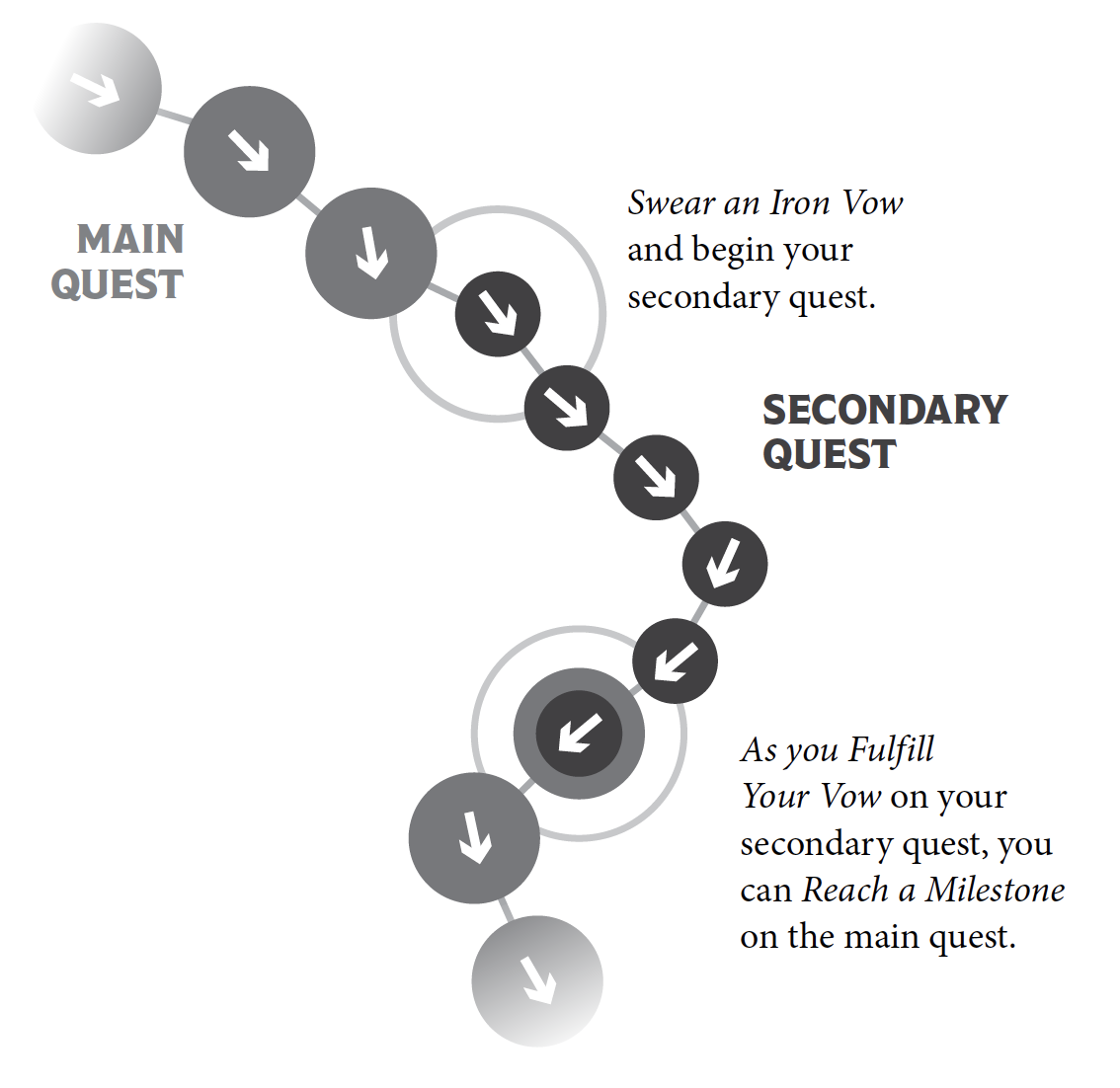
As you undertake a quest, you may make a promise or work to overcome an obstacle which is worthy of its own vow. Imagine this as a gap in your path, bridged by a set of milestones. This shorter path is your secondary quest. You will Swear an Iron Vow, give it a rank, and mark progress as you work to resolve this new vow.
You won’t mark progress on your main quest until you Fulfill Your Vow on the secondary quest. When the two paths converge, when your secondary quest is complete, you can Reach a Milestone on your main quest and continue along your path.
When is an obstacle its own quest instead of just a milestone? Look to the fiction. Is it a significant, self-contained challenge? Is it meaningful to your character? Does it create opportunities for new drama and conflict? If so, it’s probably worthy of a vow.
Example
You defeat the raiders, but it’s a hard-won victory. You are wounded and your shield was shattered. Luckily, you are able to interrogate one of the surviving raiders. You play out the scene as you Gather Information to learn how the Blood Moon clan is involved in the overseer’s illness.
Through a hit on that move and some questions to the oracle, you discover the raiders are indeed at the heart of this problem. An assassin traveling with the trade caravan is poisoning the leaders of Ironlander villages. The resulting strife will weaken those villages and make them ripe for the picking. Come winter, the raiders will sweep across this region like a dark tide.
You also learn the nature of the poison. It is extracted from a rare plant found only in the heart of the Deep Wilds. Your mother’s schemes have grown more elaborate since you last fought beside her.
These discoveries are worth another milestone. You Reach a Milestone and mark progress. This gives you a total of four progress on your dangerous vow.
What next? You look back at your quest outline and are reminded of your story prompt: “Get help from the herbalist who lives deep in the Tanglewood.” Seeking out a reclusive herbalist—who can hopefully provide an antidote for the poison—sounds like a good fit for the story.
You decide to gloss over the expedition into the Tanglewood and forgo the Undertake a Journey move. You’ll just put the forest nearby for the purposes of your narrative. You’re familiar with this herbalist, you decide, because she occasionally visits your village to trade.
You roleplay a scene as you arrive at her ramshackle hut and try to convince her to concoct an antidote for the poison. You envision her as a cantankerous, eccentric woman, unconcerned with your quest. You try to Compel her. Unfortunately, you score a miss. Not willing to let your narrative hit a dead end, you decide she will—per the move—“make a demand which costs you greatly” Being forced to commit to a secondary quest sounds about right. For good measure, you Pay the Price and suffer -2 momentum to reflect the lost time.
“A nest of harrow spiders is scuttling about,” she says. “Kill the brood mother, and bring me her fangs. I’ll need them for the antidote anyway.”
She hands you an iron coin. “Swear it, or be gone. Your choice.”
You Swear an Iron Vow. There is work to be done…
Unrelated Quests
You may encounter situations—unrelated to your current vows—which your character is driven to set right. This may happen organically through the fiction, via oracle prompts, or as introduced by your GM in guided play.
If you ever find yourself without a vow, are having difficulty envisioning the next steps in a current quest, or you want to explore a new narrative, make something happen. Introduce a problem. You can use quest starters in this book, or Ask the Oracle and interpret the answer.
Several moves explicitly provide opportunities to undertake new quests as part of their outcomes. For example, if you Sojourn and choose the option to take a quest, you can introduce a trouble which this community is facing. Or, when you Forge a Bond or Compel and roll a weak hit, the NPC demands something of you. If appropriate to the fiction, this demand may require a sworn vow.
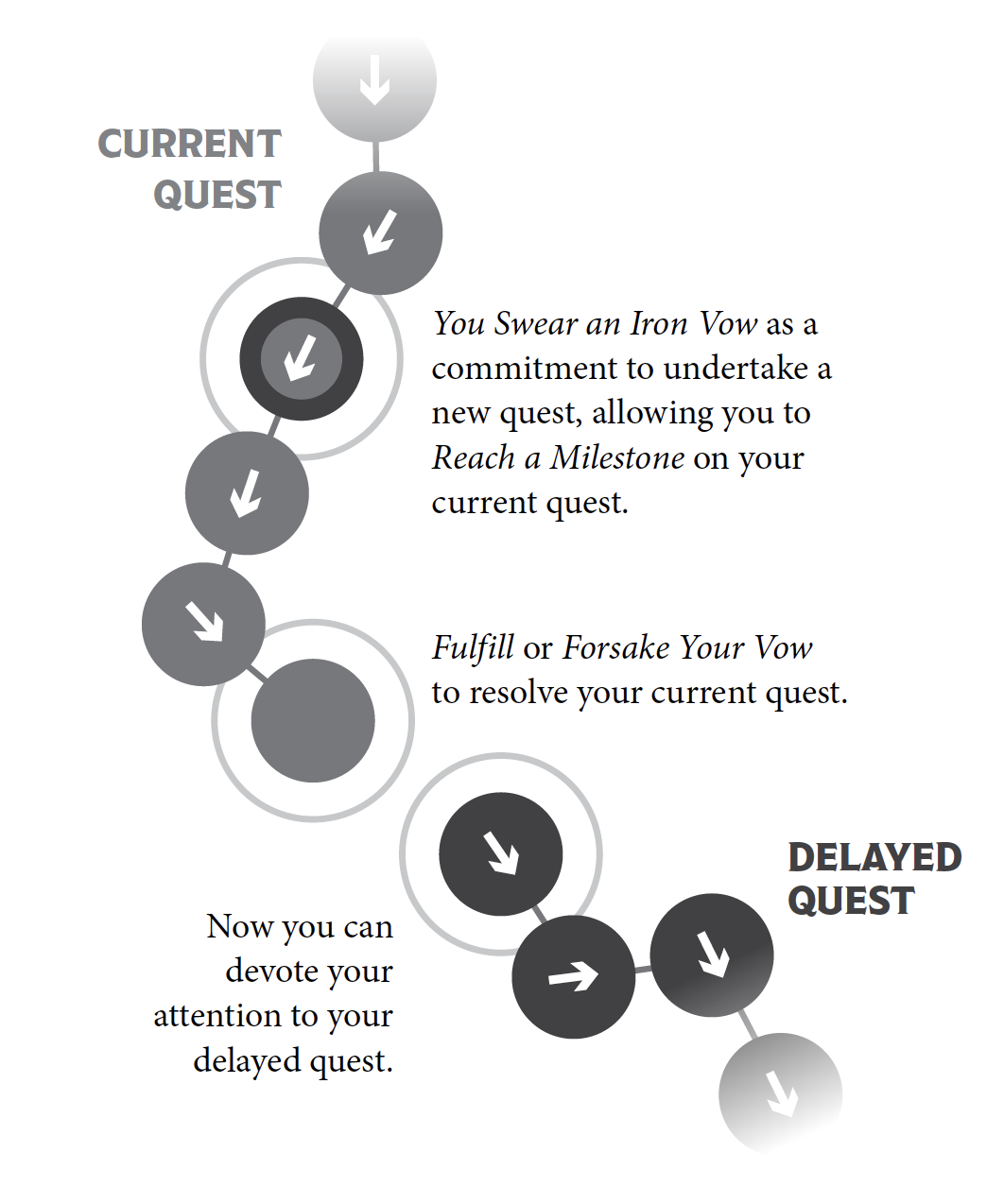
Delayed Quests
A quest may require you to gain something from an NPC. It might be information, an item, or aid of some other sort. However, as the outcome of a move or through the fiction, an NPC might have their own demands. They may even want you to Swear an Iron Vow as your promise to see it done.
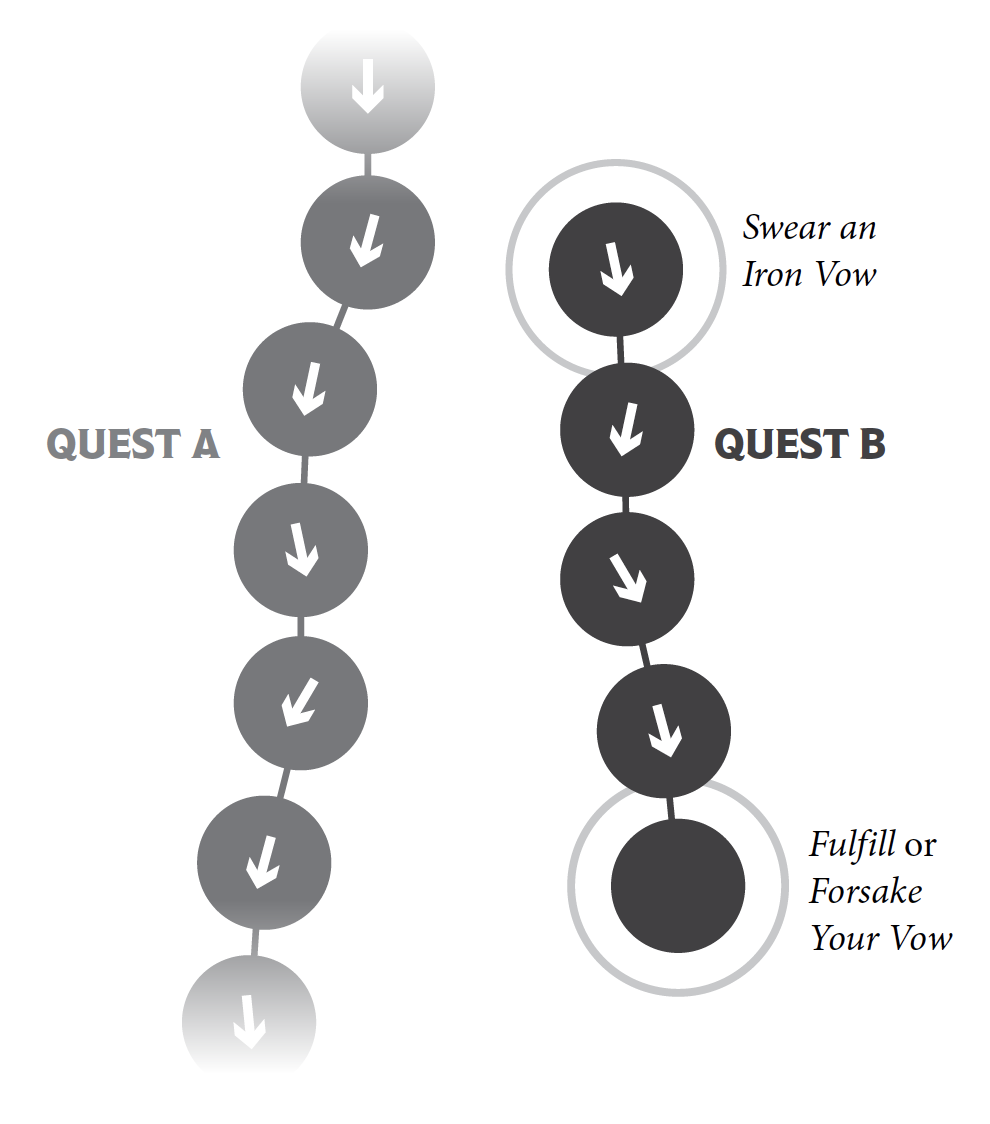
If you do so, and the NPC is satisfied with the promise itself (for now), you can continue on your current quest. You will deal with this new vow later. If the aid of the NPC is a significant step forward on your current quest, you should Reach a Milestone.
Keep in mind that swearing an iron vow is a sacred promise. NPCs, particularly powerful ones, will hold you to it. Ignoring it means you Forsake Your Vow, which should have dramatic implications within your narrative. You’ve made an enemy, or ruined your reputation. How will others take your vows seriously in the future? How will you?
Intersecting Quests
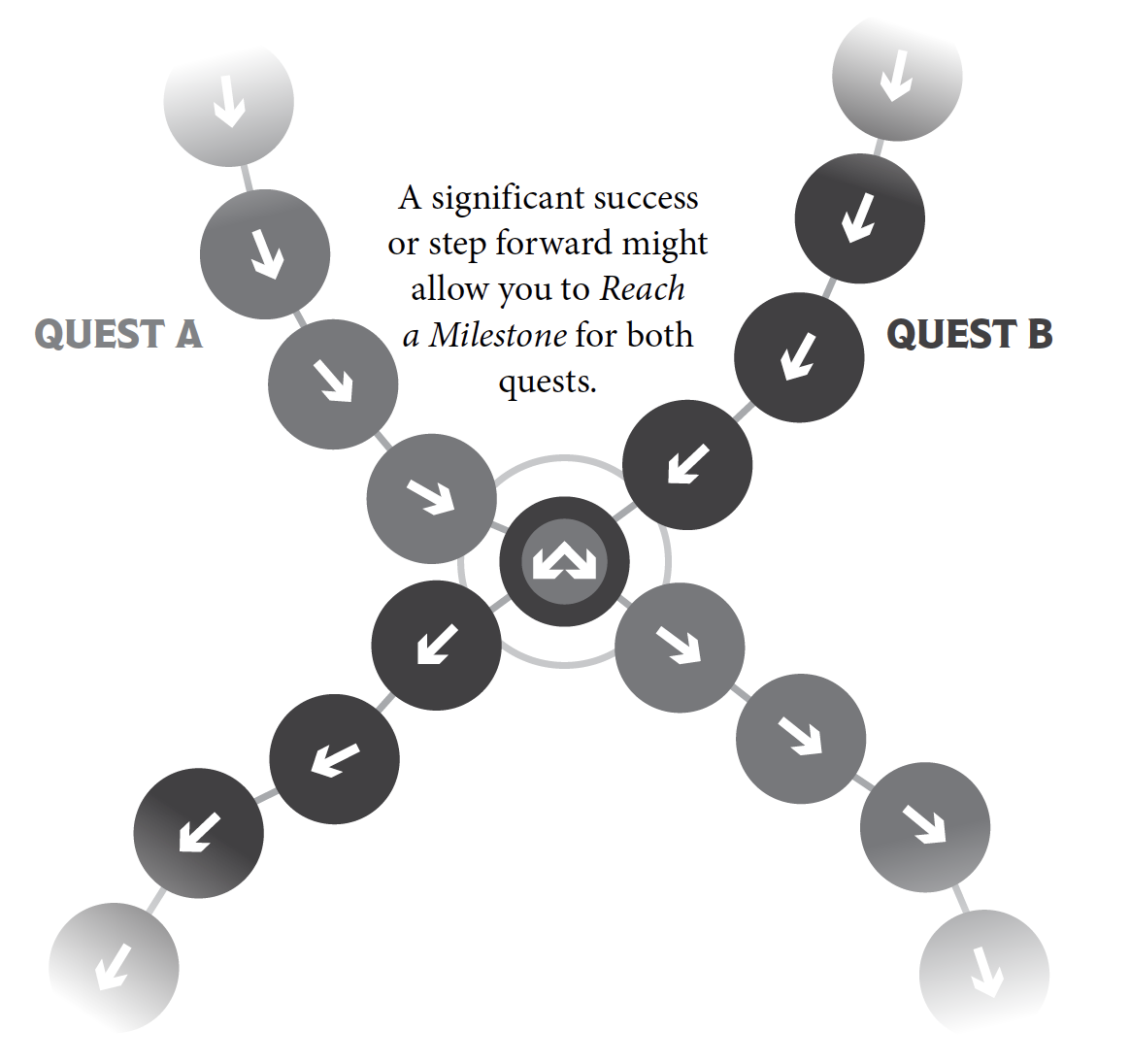
If you have undertaken two related quests, you may encounter a situation where a milestone allows you to mark progress on both vows at once. However, this should be a rare event. The two quests are not overlapping paths, with every step a milestone for each. Instead, imagine these paths intersecting at key moments.
Fulfilling Your Vow
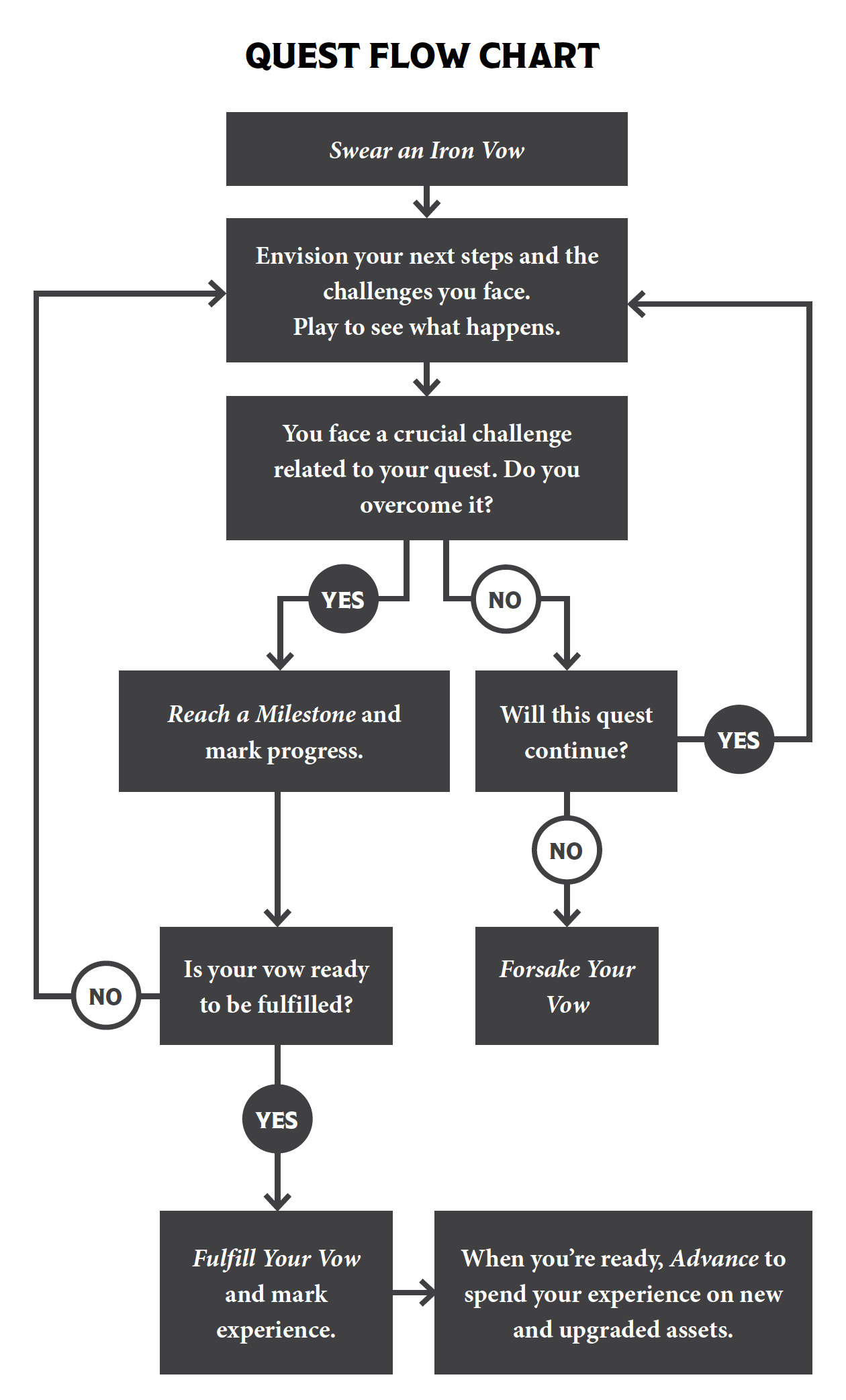
The fiction driving your quest and the mechanical progress represented by your progress track converges in the decisive moment when you believe your quest is at an end. This is when you make the Fulfill Your Vow move (page 101).
Managing your mechanical progress and the fiction to reach this moment requires a bit of stagecraft. It’s the end of the third act. Your actors need to be in position. Your sets and props need to be in place. The lights come up for the final scene…
Progress tracks can help you set the pace. If your progress track is filling up well ahead of your story, slow down the pace and focus on key objectives and turning points as milestones. If you find your story moving to a resolution well ahead of your progress track, envision some complications or twists which alter your path and create new opportunities for milestones.
However, keep in mind it’s not necessary to fill your vow’s progress track before you Fulfill Your Vow. Has the fiction led you to a moment when your quest seems complete, but your progress track is not even half full? Go with it. A weak hit or miss on the Fulfill Your Vow move can create interesting stories and reveal opportunities for new vows.
Example
Playing as Saskia, you have killed the harrow spiders at the behest of the herbalist. You Fulfill Your Vow for the “Kill the Brood Mother” quest. This also allows you to Reach a Milestone on your “Save the Overseer” quest as the herbalist concocts an antidote.
You Undertake a Journey back to Cinderhome. Since this is a return trip, and you don’t want to give it much story focus, you set it as merely troublesome. You are waylaid by a tense encounter with a protective ash bear and her cub, but eventually Reach Your Destination. This final journey also serves as a milestone on your quest. You now have eight boxes marked on your progress track.
You envision the scene as you rush to the overseer’s bedside. She is as pale as death, her breathing so shallow it can barely be detected. Are you too late? Was this all for nothing? You make the Fulfill Your Vow move to find out.
You roll the challenge dice. It’s a strong hit. You envision the overseer slowly improving. The color returns to her face. After a time, she wakes.
Your vow is fulfilled. You earn 2 experience for the dangerous quest, and 1 bonus experience because of your Banner-Sworn asset.
Forging New Bonds
As you pursue your quests, the relationships you form and the hardships you endure with other characters can be given fictional and mechanical significance through the Forge a Bond move (page 74).
A new bond can be a natural outcome of a successful quest. When you successfully Fulfill Your Vow in service to a person or community, you may reroll any dice if you Forge a Bond with them.
Example
You envision the overseer’s wife cutting a braid from her hair and giving it to Saskia, a token of appreciation and respect. You kneel, and apologize that you have nothing to give but your continued service to Cinderhome and the overseer.
You make the Forge a Bond move, and roll a miss. Luckily, your successful quest lets you reroll any dice. You roll again, score a strong hit, and mark the bond on your character sheet.
Advancing Your Character
When you successfully Fulfill Your Vow, you earn experience points. This experience is spent to purchase or upgrade assets through the Advance move (page 103).
When you focus on your skills, receive training, find inspiration, earn a reward, or gain a companion, you may spend 3 experience to add a new asset, or 2 experience to upgrade an asset.
You can spend your experience points when they are earned, or save them up for future use. Either way, you should look to the fiction to give context and justification for your new abilities. You can guide your story toward an asset you would like to purchase or upgrade, or let your selection of assets flow naturally from your character’s goals and the situations you encounter.
Assets can even serve as the focus of a new vow, giving you a tangible objective or reward for undertaking a quest. If you Swear an Iron Vow to become a skilled Swordmaster, you can make progress in that quest by seeking out training, demonstrating your prowess, and commissioning the crafting of a fine blade. When you Fulfill Your Vow and spend experience on the Swordmaster asset, it will be a satisfying and rewarding resolution of your quest.
Some more examples of connecting assets to your story and vows:
- You Swear an Iron Vow to guard a trading caravan. The trader promises you a fine set of armor in payment. When you Fulfill Your Vow, you take your reward and are Ironclad.
- You find an abandoned village in your travels and discover a forgotten, malnourished Hound. You nurse it back to health and it becomes a loyal companion.
- Each night at camp, you spar with your ally. When you Advance, you upgrade your Skirmisher asset.
- You travel far in your quest, through deep woodland and over high hills, and become a Wayfinder.
- After you Face Death, you return to the world to find a Raven perched in a branch above you. It looks at you with knowing eyes.
- You witness a priest perform a miracle, and become a Devotant.
- You paint your family’s emblem on your shield, singing the songs of your ancestors, and add a new Shield-Bearer ability.
- You defeat a powerful warrior in ritual combat, and word spreads of your skill as a Duelist.
- You have reoccurring dreams of flying high above the Ironlands, seeing the world through the sharp eyes of your hawk companion. These dreams grant you the insight to upgrade your Totem ritual.
- You swear to recover your family’s ancestral sword from a notorious raider. When you do, you are Blade-Bound.
- You were maimed in battle, but choose to persevere as one of the Battle-Scarred.
- You have witnessed death and brought it upon others. You have stood at the edge of the shadow lands and seen what lies beyond. This dark knowledge allows you to perform the Communion ritual.
- You swear loyalty to an ambitious overseer, and become Banner-Sworn.
- You vow to become a master of the mystic arts, and undertake a quest to train under an elder mystic. When you complete your training, you are a Ritualist.
Envisioning how your new abilities connect to your sworn quests and experiences gives them additional significance and context. They will be a reminder of the paths taken and not taken, the challenges overcome, and the bonds formed.
Example
You earned 3 experience on your quest to save the overseer, enough to purchase a new asset. You Advance, and buy a Horse companion. You envision the overseer and her wife giving you Nakata, the horse who saw you through your perilous journeys.
Nakata will serve you well. You would like to go back to your simple life as a farmer, but the raider’s plot must be stopped.
It’s time to face your past.
Quest Flow Chart