Hacking Ironsworn
Playing in Other Worlds
If you want to play in a different setting—but one that is similar to the Ironlands in tone—you can jump right in. Ironsworn characters, moves, and assets can make the transition to similar gritty fantasy or historical settings with very few changes, if any.
When you create your character, you can omit any assets which aren’t a good fit for your setting. For example, rituals might be left out or limited if there is no magic in your world.
Make the world fit your character
Ironsworn works best when portraying driven heroes undertaking perilous quests. Vows, milestones, and progress tracks are core to the game, and should not be left behind when you explore other settings and genres. If iron vows and sworn quests don’t fit your world, you can change how they are represented in the fiction. A solemn promise can take many forms.
High-Magic Settings
A bigger shift in tone may require more work. If you play in a setting where mystic forces are more powerful, you’ll need to consider how to handle magic for your character. The easiest option is to simply create a character without magic capabilities and depict the magic of the setting and NPCs through the fiction. Your story gains the potential advantage of showing your mundane character standing against overwhelming supernatural forces.
For magic-wielding characters, ritual assets can be envisioned with overt magical effects in high-magic settings. For example, instead of simply wearing an animal pelt using the Bind ritual, you can actually shape-change into the creature. The mechanical outcomes can stay the same, but the fictional framing changes dramatically. Rituals might also be envisioned to require less time to prepare or perform, functioning more like the quick-fire spells of heroic fantasy roleplaying games.
If your setting or character concept don’t work within the confines of existing assets, you have some options to consider on the next page.
Exploring Other Genres
Ironsworn characters and moves are intentionally only lightly themed for the default setting and tone, and they work just fine across a variety of heroic fiction genres. Undertake a Journey can be envisioned as faster-than-light travel aboard a spaceship, or as nitrous-fueled journeys on the ruined highways of a post-apocalyptic wasteland.
Assets are designed to reflect Ironsworn’s default world, and require more work to ignore, transition or replace for dramatically different settings and genres. Some options follow.
Tweaking Assets
Playing without Assets
Playing without assets limits the options for your character, but simplifies things if you prefer less mechanical detail. It also makes it much easier to quickly reskin Ironsworn for other settings or genres.
If you do play without assets, you should give your character additional depth through roleplaying and description. Envision your character’s background and skills to help define the fictional framing of your actions.
For anything other than a very short campaign or one-shot, you need an alternate reward when you spend experience. Here’s a suggestion:
When playing without assets, you may spend 6 experience to increase a single stat by +1. No stat can exceed +4.
Using Roles instead of Assets
If you aren’t using assets but want to add a bit more detail to your character, you can use a simplified representation of assets called a role. Here’s how it works:
- Name a role for your character based on their expertise or background. In the Ironlands or a similar setting, you might be a leader, scout, mystic, or healer. If you are hacking Ironsworn for a different setting or genre, use roles which fit the world. If you chose a combat-oriented role, make it narrow enough that it isn’t usable for every potential action in a fight.
- Your role gives you the fictional framing to act using that role in your story. If you are a scout, you are skilled at finding your way in the wilds and observing the enemy from hiding. If you are a mystic, you can perform rituals. If you are a leader, you can command others. You make moves as normal, but the fictional framing might give you permission to make or avoid specific moves, and affect how you envision your actions.
- If you like, give your role greater story potential and specificity with an evocative label. You are not just a priest, you are a Wayward Disciple of the Forgotten One. You are not just a hunter, you are a Sharp-Eyed Hunter of the Hinterlands.
- When you make a move (not a progress move) and envision how your role contributes to this action, choose one before rolling: Add +2, or add +1 and take +1 momentum on a hit.
- For every 6 experience points, you may buy an additional role. Name it, and write it down. Bonuses from multiple roles may not be combined for a single move. If your roles overlap for a particular action, envision which role provides the most influence over your intent and outcome.
Reskinning Assets
Because many of the assets represent the typical tropes of heroic characters, they can often be reimagined for different settings and genres with minimal changes. Use the existing assets as a starting place, and adjust the labels and specific abilities to better fit your imagined world.
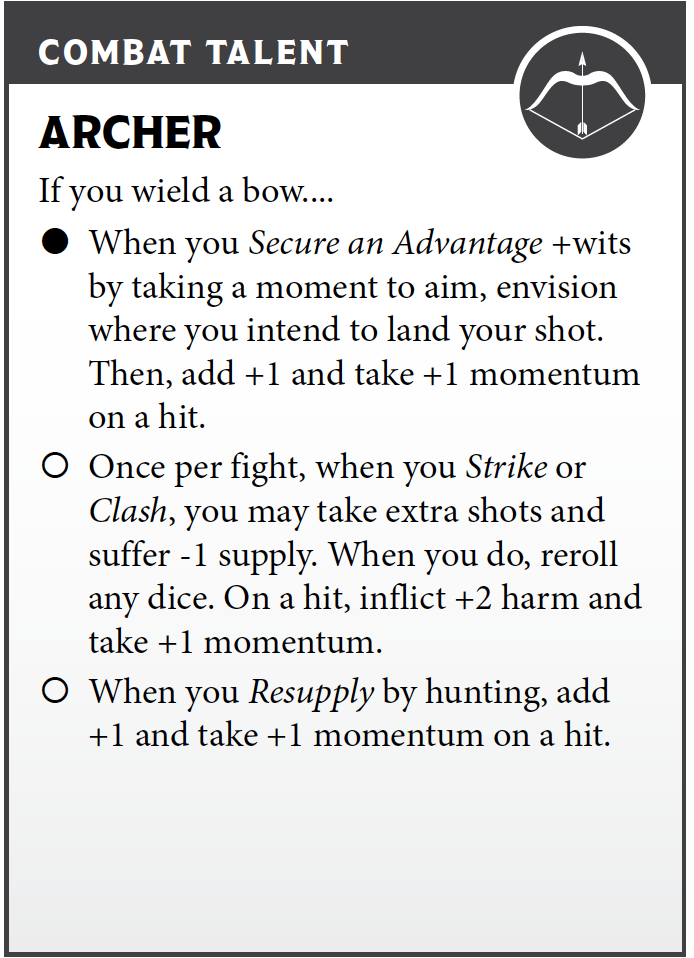
- Are you a 17th century pirate who is a crack shot with your musket? Rename Archer to Marksman, and change the condition to “If you wield a musket…”
- Are you playing a cyborg in a future dystopia? Rename Archer to Gunner, and change the condition to “If you wield a cybernetic blaster…” Then, swap out the last ability with something that better fits the theme.
Creating Assets and Abilities
If you want to create new assets or update an existing asset to better fit your theme, look to the existing abilities as your model. Assets provide several types of mechanical benefits, including:
- They grant a moderate benefit, such as “add +1 and take +1 momentum on a hit”, for a relatively common action you expect to perform a few times each session.
- They grant a strong benefit, such as “reroll any dice”, for less common actions or abilities which have a limit (“one time only”). You can also grant strong benefits for abilities which require setup moves or strict fictional framing. For example, to use the Slayer’s “reroll any dice” ability, you must first kill a formidable beast.
- They give you an option to exchange one resource for another, such as “suffer -1 momentum and inflict +1 harm on a hit.”
- They provide the fictional framing to make a move in unusual circumstances. For example, you can use the Communion ritual to Gather Information from the dead.
- They allow you to use a different stat instead of the one normally required by a move.
You will find various permutations of these rewards across the default assets, along with many other less common abilities and self-contained moves which are specific to an asset.
One technique you can use when creating a new asset is to mix-and-match abilities from other assets. Whatever you want to portray in the fiction can probably be cobbled together, with some mild tweaking, from abilities which already exist.
A final word: Ironsworn is not particularly concerned with strict mechanical balance between assets. You aren’t going to break anything by experimenting. If it adds to your fun, it’s working.
Get help online
Of course, the easiest way to play Ironsworn in different worlds is to let someone else do the work. Visit ironswornrpg.com for updates on official expansions and community-created content.