Starting Your Campaign
An Ironsworn campaign is a series of connected game sessions. You will explore your world and the life of your character as you swear vows and struggle to see them fulfilled. You will journey across the Ironlands, run afoul of troubles, fight fearsome foes, and form bonds with people and communities. Through it all, you make decisions as your character and explore what it means to be Ironsworn in a harsh land.
To get started on your campaign, follow the steps described in this section.
Create Your Character
Refer to the character creation summary on page 47. Envision your character, considering their motivations, skills, background, appearance, personality, and connections to the world. Set your stats and pick your assets in whatever order you prefer. Give your character a name.
If you are playing co-op or guided, talk over your character with the other players and establish your connections to each other. You can shorthand your ideas for now, and flesh them out in play.
Feel free to intermix world creation and character creation. The choices you make about your setting may determine the options available to your character. Is magic unknown in this world? If so, you may want to ignore the ritual assets.
Example
You envision your character. Your family was part of a raider clan. You were born to battle, but left that life behind long ago. Now, you live as a farmer. Your sword, long unused, hangs above the mantle in your modest home. Your armor is stored in a chest at the foot of your bed. Only those closest to you are aware of your former life among the raiders. Others know you for your loyalty to the village and your stubborn determination to help see them through the unforgiving winters. In quiet moments, your dark mood betrays the shadows of your past.
You set your stats. Your iron is 3, representing your strength, prowess in battle, and fierce resolve. Then, 2 for heart and wits, and 1 for edge and shadow. For your assets, you choose Shield-Bearer and Veteran. You’re not sure about your third asset, so you decide to pick it once you are further along in creating your world and starting situation.
Finally, you give your character a name: Saskia.
Create Your World
If you are playing in the Ironlands or a similar setting, work through the ‘Your Truths’ exercise starting on page 122. Review the options and make selections. Keep an eye out for quest starters which trigger an idea for a background vow (page 195) or an inciting incident (page 196).
Next, choose where your story begins. Have a look at the regions on page 112. Where are your characters located? Are they part of a community, or wandering the wilderness? Talk it out with other players and envision the setting. Mark the location on your map.
Example
You envision some basic characteristics of your home village. It is a small settlement along the southern fringes of the Havens. It is surrounded by fields and sits astride a wide river.
You roll on the Settlement Name table (page 178), and the oracle answers, “Cinderhome.” You envision the burnt ruins of the former longhouse. It is a place haunted by a long-dead overseer who died in the fire.
You mark Cinderhome on your map. This is where Saskia’s adventures begins.
If you prefer, you can just spend a few moments defining some basic facts for your world. Jump in and discover the rest in play.
If you are using your own setting or one drawn from another source (such as an RPG, book, or film), you can leverage the information on that setting to determine your character’s situation and the troubles you may encounter.
Collaborating to Build Your World
If you are playing a co-op or guided campaign, you should work through the initial process of worldbuilding with the other players. Depending on your preferences, you can spend a few minutes quickly roughing out the basics of your setting, or you can dive deep for an hour or two of collaborative creation. Talk it over with the other players to ensure you have the same expectations for your initial session. Even if you give this initial activity some focus, leave open questions and blank spaces to fill in through play.
If you are the GM, you should facilitate discussion and contribute to the worldbuilding. Take cues from the players and make suggestions to help formulate potential quests and adversaries.
Mark Your Background Bonds
Give yourself up to three bonds (page 36). These bonds may be to a community or an individual. You do not need to make the Forge a Bond move for these starting bonds. Mark a tick for each bond on your character sheet (1 tick per bond), and make note of them.
If you are playing guided or co-op, you can use these starting bonds as your connection to other player characters. Otherwise, you may establish bonds with those characters though play.
If you’d rather jump right into play, you can flesh out the details of your background bonds later. Consider these bonds held in reserve until you decide to bring them into your narrative. If you later introduce a background bond for a character or community, mark the bond. Then, envision how this bond was previously established and how this relationship impacts your story.
Example
You mark one bond for your home village. You also envision an NPC, the clan overseer, who is a good and loyal friend. She is one of the few who knows of your former life as a raider, but does not hold it against you. “We can remake ourselves,” she once told you. “Like a broken sword reforged.” You give her a name and mark the bond.
You don’t have any ideas for your third bond, so you keep it in reserve. You can allocate it as you explore your starting situation.
You decide the background bond with the overseer fulfills the requirement of the Banner-Sworn asset (“When you mark a bond with a leader or faction”). You take it as your third and final asset.
Write Your Background Vow
When you create your character, you give yourself a background vow to represent a primary motivation or ultimate goal. This vow is part of your character’s backstory. It may be a vow sworn years ago, or one which is a reaction to some recent, major event.
Write down this vow and give it a rank of extreme or epic. You don’t need to make the Swear an Iron Vow move for this quest.
Fulfilling this vow will not be easy. In story-time, it might require months, years, or even decades to see this vow fulfilled or forsaken. You may even decide your background vow isn’t something you make significant progress on in your narrative. Instead, it just helps establish some roleplaying detail for your character and fleshes out your world.
Example
Your backstory involves your former life as a raider. Haunted by your past, you have sworn to see this raider clan defeated. However, there are complications. The clan is powerful, and you couldn’t possibly hope to defeat them without an army at your back. Also, the clan is led by your own mother. It’ll take a special sort of courage to face her again.
You envision the clan’s name: “Red Moon.” Their shields are decorated with a blood-red circle.
For now, this vow is a glowing ember, a promise not yet sparked to flame. You mark the vow as “Defeat the Red Moon clan”, giving it a rank of extreme.
Envision Your Inciting Incident
An inciting incident is the problem which arrives at the beginning of a story, propelling the protagonist into action. Everything up to that point is backstory—the normal world to which your character has become accustomed. In Ironsworn, the inciting incident is the tipping point which forces you to undertake a life of perilous quests and adventure.
To start your character’s story, envision an imminent threat or compelling need. You can use a quest starter from this book (see chapters 4 and 5), talk it out at the table, or Ask the Oracle (page 107). This problem dictates what drives your first session and sets your character’s story in motion.
What makes a good inciting incident?
- Make it personal. Why is this important to your character? Envision how this connects to your background and motivations. Also, consider how you can leverage story themes which are interesting to you as the player.
- Make it a problem that won’t go away on its own. The threats or forces at the heart of this situation will see it through, even if you ignore them.
- Give it a ticking clock. The problem won’t wait for you. If you don’t act or encounter delays, things will get worse.
- Make it universal. If you are playing with allies, make this a shared vow—important to each of you. This creates an opportunity to work together. If you are playing solo, make it a threat which impacts other people you care about.
- Up the stakes. Envision complications which make your inciting incident even more dire for you, your family, or your community.
- Limit the scope. Unlike your background vow, this is a problem which you can (and must!) deal with now. In gameplay turns, you Swear an Iron Vow and mark it as a troublesome, dangerous, or formidable quest. If all goes well, it might be resolved in a session or two. If you don’t act, things will get worse.
These suggestions can apply to any vow, but are especially relevant for an inciting incident. Even if the details are not clear to you, envision how the problem can lend itself to a rich narrative full of drama, conflict, and surprises.
Example
A mysterious sickness has struck Cinderhome’s overseer. The village healer brewed draughts, but none offered any relief. The priest prayed, but the gods did not listen. The mystic performed divinations, but the shadows did not divulge their secrets.
The overseer, your friend, is fading. Without help, she will surely die.
To add a bit more drama and stakes, the families in your community are now at each other’s throats as they start to position their preferred candidate to take up the iron circlet. If the overseer dies, open conflict may break out. The community will be weakened and may not survive the coming winter.
You pile on the stakes until it feels like an imperative. You must take on this quest.
Set the Scene
You have two options for starting play: You can begin with the normal world, or in media res.
The Normal World
Envision a prologue involving your character which helps to flesh out who you are and how you interact with your world. If you have allies, this is an opportunity to roleplay your relationships and introduce your personality and backgrounds. Your inciting incident can then serve as an event or threat which you encounter in play during your first session.
Example
You want to spend a bit of time exploring your character and your world before you kick things off with your overseer’s sudden illness. Your village is celebrating the spring festival, and you are taking part in a boar hunting competition. You roleplay scenes and make moves as you interact with other hunters, track your quarry, and attempt to bring down a particularly large and vicious boar. When you return to the village, you learn that the overseer has fallen ill.
If you are having trouble coming up with your initial quest, you can use the prologue to jump in and discover a dramatic situation through play. Ask questions about the characters, your world, and the current situation. Draw conclusions to those questions or Ask the Oracle. Look for opportunities in the fiction to trigger a vow.
In Media Res
In media res is a Latin term meaning “in the middle of things.” You start your story at a crucial point. Your inciting incident is happening now, or is something you are fully aware of and must react to. The raiders are attacking. The usurper claims the iron circlet. The marauding beast appears.
You can begin with a tense, action-oriented scene as you encounter the problem. Or, you might frame a scene where you Swear an Iron Vow, letting the result of that move trigger what happens next.
Example
You envision a scene in the longhouse as you visit your stricken overseer. She lies in bed, her features as pale as death, her breathing ragged. There are others here: The village healer, the overseer’s wife, and a rival who feigns concern. Ignoring them, you stride forward. You draw your sword…
Swear an Iron Vow
To set your quest in motion, as a response to the inciting incident, make this move (page 98). But first, start with the fiction. Envision the scene. Describe what you say and how you perform the ceremony. This is an important moment for your character.
What was the result of your move?
- Did you score a strong hit? Envision your first steps. Do you Undertake a Journey? Do you Compel someone into action? Play to see what happens next, and make moves as appropriate.
- Did you score a weak hit? Your next steps are unclear. This may typically lead to new scenes and new moves. Perhaps you Gather Information (page 62) as you try to identify a path forward.
- Did you score a miss? An unexpected danger or obstacle stands in your way. Envision what it is, or Ask the Oracle (page 107). Then, play to see what happens as you attempt to overcome this stumbling block.
For an inciting incident, give your new vow a rank of troublesome, dangerous, or formidable.
Example
You envision the scene as you kneel before your overseer. You curl your hands tight around the iron blade of your sword—so tight that you open a cut in your palm. You pay the wound no mind. The blood fuels the promise. “I will see you healed,” you say. “I swear it.”
You roll the dice. Because you have the Banner-Sworn asset and serve the overseer, you may reroll any dice. It’s a strong hit. A good omen. You write your vow on your character sheet and give it a rank of dangerous. Per the move outcome, “you are emboldened and it is clear what you must do next.” What do you know about this disease? What’s your likely path forward? Envision the answer, talk it out, or Ask the Oracle (page 107).
Sharing Your Vow with Allies
If you are playing with allies, only one of you will make the Swear an Iron Vow move. Other players can make the Aid your Ally move (page 76) as a way of representing their own commitment to this vow. If you share this quest with your allies, each of you write the vow and any progress is marked by all players.
Next Steps
Depending on the result of your Swear an Iron Vow move, your character may have a clear path forward, may have more questions than answers, or may need to overcome an immediate obstacle or threat before they can undertake their quest. You, as the player or GM, interpret what this result means. Not sure where to begin? Ask the Oracle.
Example
You’ve sworn your vow and scored a strong hit, which means the next steps—from your character’s perspective—are clear. As the player you don’t know where to begin. Are there any clues to the source of the sickness? You Ask the Oracle by rolling on the Action and Theme tables (page 174).
The oracle answers, “Leave” and “Trade.” What does it mean? Your first instinct is to interpret this answer as having something to do with a trade caravan. Perhaps one left your village on the same day the overseer fell ill? There must be a connection.
With your immediate goal in sight, you can roleplay your preparations and Undertake a Journey (page 65) to set off after the caravan.
Creating a Quest Outline
If you find it helpful, you can envision and write down the main narrative steps in your quest. What journeys must you undertake? Which enemies will oppose you? What information must be found? Who do you need help from?
Your outline should give you ideas for the scenes and challenges which can be part of your quest, with each major step an opportunity to make the Reach a Milestone move (page 100). However, you should consider it a sketchy, unreliable plan at best. It is like an ancient map with “here there be monsters” written in blank spaces.
If you are a GM and have some ideas for challenges and events in the quest, make note of them. However, don’t get locked into a specific path which must be followed. Whether you are a GM or a player, leave yourself open to surprises, new ideas, input from others at your table, and the whims of fate. Be prepared to toss even the mostly loosely defined plan out the window.
Put simply, play to see what happens.
Example
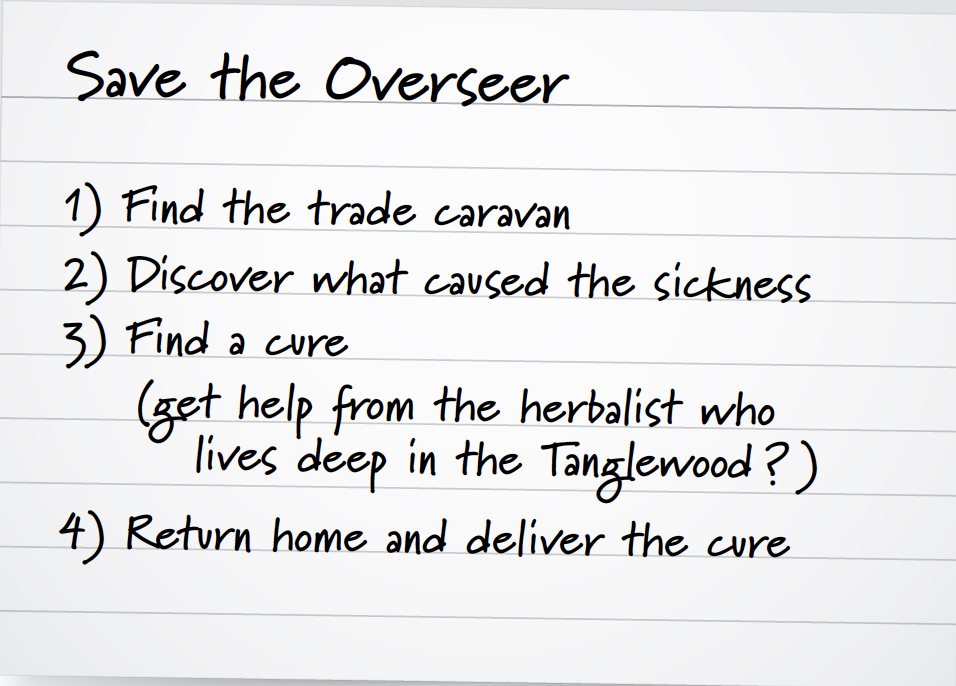
You consider the steps you’ll take to Fulfill Your Vow. You need to find the caravan, identify the cause of the illness, locate a cure, and return back to Cinderhome to heal the Overseer. You write the milestones down.
In your outline, you include a note about a healer in the Tanglewood forest. You like the idea of a woodland adventure and a mysterious old herbalist who may want something in exchange for a cure. Your story might not lead in that direction, but it gives you an interesting potential narrative checkpoint.
That’s four milestones, which is about right for a dangerous quest (two progress per milestone). But, these may change depending on where the story takes you. At the moment, much is unknown.
Campaign Setup Summary
Create your character (page 193). Envision your character. Choose your name, set your stats, and select your assets. Refer to chapter 2 (page 31) for details. If you prefer, you can start by creating your world (below).
Create your world (page 194). If you are playing in the Ironlands, refer to chapter 4 (page 111) and the ‘Your Truths’ exercise (page 122). Otherwise, establish the basic truths of your own world. Envision where your story will begin and mark it on your map.
Create your background bonds (page 195). Mark up to three bonds to represent your connections to home, friends, family, or other loyalties. Make note of these bonds, and mark a tick for each.
Write your background vow (page 195). Create a sworn quest as backstory for your character. Write down this vow and give it a rank of extreme or epic. You don’t need to make the Swear an Iron Vow move for this quest.
Envision your inciting incident (page 196). Come up with the problem that drives your character into action.
Set the Scene (page 198). Decide whether you want to start with a prologue (the normal world), or in the midst of the problem (in media res). Envision the scene and begin play.
Swear an Iron Vow (page 199). Make the move and write down your vow. Give it a rank of troublesome, dangerous, or formidable.
Take your next steps (page 200). Based on the outcome of your Swear an Iron Vow move, envision what you do or what happens next. If you like, you may outline the milestones of your adventure. Then, play to see what happens.